
Home » Gallbladder Removal Surgery
Gallbladder Surgery (Cholecystectomy) in Singapore
Learn when minimally invasive gallbladder surgery is performed to treat gallbladder conditions and what to expect.

Dr Thng Yongxian
Medical Director & Senior Consultant Hepatopancreatobiliary Surgeon
Keyhole Gallbladder Surgery Specialist
MBBS • MMed • MRCS (IRE) • FRCSED • FAMS
Table of Contents
- What Is Gallbladder Surgery
- Who Needs Gallbladder Surgery
- Symptoms of Gallbladder Conditions
- How Are Gallbladder Conditions Diagnosed
- Why Is Gallbladder Surgery Done
- What Is Laparoscopic Cholecystectomy (Keyhole Surgery)
- Who Performs Gallbladder Removal Surgery
- What Happens Before, During and After a Cholecystectomy
- Gallbladder Surgery Recovery Timeline
- Are There Long-Term Effects of Gallbladder Removal
- Cost, Insurance & Medisave
- Frequently Asked Questions (FAQ)
Overview: Gallbladder surgery, or a cholecystectomy, is the surgical removal of the gallbladder. It's a common and safe
procedure generally performed to treat symptomatic gallstones, inflammation, polyps or gallbladder cancer. Because the
gallbladder is a non-essential organ (meaning a person can live a normal, healthy life without it), most people resume light
activity within a week and reach full recovery in 2 to 4 weeks.
Not everyone with a gallbladder issue needs surgery, and the reasons for it go beyond gallstones alone. Here's what to know
before your consultation.
What Is Gallbladder Surgery
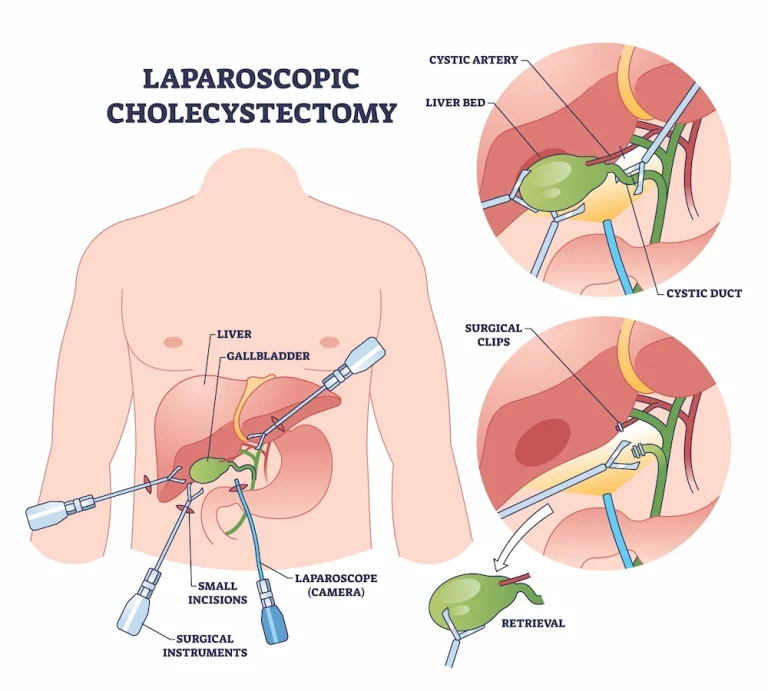
Gallbladder surgery, medically known as a cholecystectomy, is the surgical removal of the gallbladder, a small pear-shaped organ beneath the liver that stores bile.
The gallbladder plays a supporting role in digestion. Once it’s removed, the liver continues producing bile and it flows directly into the small intestine, allowing the digestive system to function normally with minor adjustments.
Who Needs Gallbladder Surgery
Most people associate gallbladder surgery with gallstones, but several other conditions can lead to the same recommendation.
Gallstones
The most common reason for surgery. Symptomatic gallstones that cause recurring pain are usually treated by removing the gallbladder entirely, since the stones tend to recur even if only removed on their own.
Gallbladder Inflammation (Cholecystitis)
Often caused by a gallstone blocking the gallbladder’s outlet, leading to swelling and infection. This can become urgent and typically requires surgery
Gallbladder Polyps
Most gallbladder polyps are small and harmless, but larger or growing ones carry a risk of becoming cancerous and are usually removed as a precaution.
Gallbladder Cancer
Surgery is a primary treatment for gallbladder cancer when it’s confirmed or strongly suspected, sometimes alongside other cancer treatments.
Bile Duct Stones or Blockages
Occasionally a stone moves into the bile duct itself. This may need an additional procedure alongside or instead of gallbladder removal.
You may also be a candidate for surgery if imaging shows a gallbladder that’s stopped functioning properly, even without stones, or if you’ve had one severe attack that’s raised your risk of a repeat episode.
Symptoms of Gallbladder Conditions
Symptoms vary depending on which gallbladder condition is present, but several signs are common across most of them:
- Pain in the upper right abdomen, sometimes spreading to the back or right shoulder
- Pain that worsens after fatty or fried meals
- Bloating, nausea or vomiting
- Fever or chills, which can point to infection or inflammation
- Yellowing of the skin and eyes, sometimes alongside tea-coloured urine and pale stools
When to seek prompt medical attention: sudden, severe abdominal pain, fever with abdominal pain, or the combination above. These can point to an infected gallbladder or a blocked bile duct, both best assessed quickly rather than monitored at home.
Many gallbladder problems, particularly small gallstones or small polyps, cause no symptoms at all and are only picked up when imaging is done for an unrelated reason. This is normal and not automatically a cause for alarm.
How Are Gallbladder Conditions Diagnosed
Diagnosis usually starts with an abdominal ultrasound, which is non-invasive and can pick up gallstones, polyps and thickening of the
gallbladder wall. It’s often enough to confirm a diagnosis and guide next steps.
Depending on what the ultrasound shows, your surgeon may recommend further tests:

- Blood Tests
- Check for signs of infection, inflammation or liver involvement, and can help distinguish a straightforward gallstone problem from one affecting the bile duct.

- CT or MRI Scans
- Give a more detailed view of the gallbladder and surrounding organs, particularly useful if gallbladder cancer or bile duct involvement is suspected.

- MRCP (Magnetic Resonance Cholangiopancreatography)
- A specialised scan that maps out the bile duct system in detail, useful when a stone or blockage in the duct itself is suspected rather than the gallbladder alone.

- HIDA Scan
- A nuclear imaging test that checks how well the gallbladder is emptying bile, occasionally used when symptoms are present but standard imaging looks normal.
Most people only need an ultrasound and a blood test to reach a diagnosis. Further imaging is usually reserved for cases where the picture isn’t clear, or where cancer or bile duct involvement needs to be ruled out.
Why Is Gallbladder Surgery Done
Surgery isn’t usually the first response to a gallbladder finding. It becomes the recommended path once a condition is causing symptoms or carries a real risk of complications.
Two considerations usually tip the decision toward surgery:
The Pain Is No Longer Occasional
A single mild episode after a heavy meal is different from recurring attacks severe enough to disrupt work, sleep or daily life. Once gallstone pain becomes frequent, it tends to keep recurring, and surgery is generally the only treatment that removes the cause rather than managing each flare-up.
Complications Are Developing, or the Risk Is Rising
A gallstone blocking the bile duct can cause jaundice or infection. If it blocks the duct shared with the pancreas, it can trigger gallstone pancreatitis, a painful inflammation that typically requires hospital admission. Surgery is often recommended proactively to avoid reaching this point.
What Is Laparoscopic Cholecystectomy (Keyhole Surgery)
Laparoscopic cholecystectomy, commonly called keyhole gallbladder surgery, is the standard technique used for the vast majority of gallbladder removals today. Instead of one large incision, the surgeon works through 3 to 4 small cuts, guided by a thin camera (laparoscope) that projects a magnified view of the gallbladder onto a monitor.
| Laparoscopic Surgery | Open Surgery | |
|---|---|---|
| Incisions | 3–4 small incisions (0.5–1cm) | One larger incision (10–15cm) |
| Recovery | Faster, typically 1–2 weeks for light activity | Longer, several weeks |
| Duration | Often same-day or overnight | Usually 2–5 days |
| Hospital stay | Most cases | Complex cases, severe inflammation, or when laparoscopic surgery isn't safe to continue |
Laparoscopic surgery is preferred because of its smaller incisions, lower infection risk and quicker return to daily activities.
In roughly 1 in 10 cases, a surgeon may need to convert to open surgery partway through, usually because inflammation or scar tissue makes it unsafe to continue laparoscopically. This is a normal, pre-discussed safety decision, and it’s one reason gallbladder surgery is best performed by a surgeon experienced in both techniques.
Who Performs Gallbladder Removal Surgery
Gallbladder surgery is often performed by a surgeon trained in
hepatopancreatobiliary (HPB) surgery, a subspecialty covering the liver, pancreas, gallbladder and bile duct.
This training gives HPB surgeons a strong working knowledge of the bile
duct and surrounding structures, helping lower the risk of bile duct injury
and making them well placed to manage severely inflamed or unusual gallbladders.
What Happens Before, During and After a Cholecystectomy
Before Gallbladder Surgery
You’ll have a consultation with your gallbladder surgeon to review your medical history and symptoms, followed by blood tests and imaging such as an ultrasound. You’ll typically be asked to fast for 6 to 8 hours beforehand, and any regular medications will be reviewed in case adjustments are needed.
During Surgery
A laparoscopic cholecystectomy typically takes 30 to 90 minutes, depending on the complexity of the case. The general sequence:
- General anaesthesia is administered so you're asleep throughout
- 3 to 4 small incisions are made in the abdomen
- A laparoscope (thin camera) provides a clear view of the gallbladder on a monitor
- The gallbladder is carefully detached from surrounding tissue
- It's removed through one of the small incisions
- Incisions are closed with sutures or surgical glue
Open surgery, when needed, follows the same overall goal but takes longer and involves a single larger incision.
After Gallbladder Surgery
You’ll be monitored in a recovery area as the anaesthesia wears off. Most patients go home the same day or after one overnight stay. A light diet is recommended initially, with a gradual return to normal meals over the following days, and pain is generally managed with prescribed medication for the first few days.
Gallbladder Surgery Recovery Timeline
- First week: light activities, low-fat diet, some soreness around incision sites
- 1 to 2 weeks: most patients resume light daily activities and light work
- 2 to 4 weeks: full recovery for most patients, laparoscopic cases typically recover faster than open surgery
- Ongoing: occasional mild digestive changes such as looser stools are common initially and usually settle over time
Are There Long-Term Effects of Gallbladder Removal
Most people live entirely normal lives after gallbladder removal, and long-term problems are uncommon. That said, a minority of patients notice ongoing changes worth knowing about:
Digestive Changes
- Looser stools or diarrhoea after fatty meals. Without a gallbladder to store bile, it trickles into the intestine continuously. This can mean occasional loose stools after rich food, which often improves with smaller, lower-fat meals.
- Bile reflux. Less commonly, bile flows back into the stomach and causes discomfort, usually manageable with diet changes or medication.
- Post-cholecystectomy syndrome. A small number of patients have ongoing bloating or digestive changes after surgery. This is usually mild and improves over months, but worth flagging to your surgeon if it persists.
For the large majority of patients, these effects are minor, temporary or manageable, and don’t outweigh the benefit of resolving the
original gallbladder problem.
Concerned About Your Gallbladder Health?
Consult our gallbladder surgeon for guidance on your symptoms, treatment options and making informed decisions about your care.
Cost, Insurance & Medisave
The cost of gallbladder surgery in Singapore can vary based on several factors, including the type of surgery, hospital charges and the surgeon’s fees.
Estimated Cost of Gallbladder Removal Surgery
For a more detailed breakdown, the total cost of gallbladder removal surgery ranges from SGD 20,000 to SGD 30,000, depending on the complexity of the case and hospital choice. The estimated costs are as follows:
Hospital Fees: SGD 14,000 – SGD 21,000
Professional Fee: SGD 6,000 – SGD 9,000
Medical Consumables: SGD 1,000 – SGD 2,000
Insurance and Payment Options
Insurance coverage and government subsidies are available for Singaporeans and permanent residents, which can significantly reduce the financial burden of the procedure. It is important to check with your insurance provider or explore options like Medisave to manage costs.
Consult an Experienced Gallbladder Surgeon
Whether your gallbladder issue was picked up through symptoms or an incidental scan, understanding why surgery is or isn’t
recommended is the first step toward the right decision.
Our gallbladder surgeon, Dr Thng Yongxian, offers personalised assessment and treatment across the full range of gallbladder conditions.

The specialist leading your care
Dr Thng Yongxian
Medical Director, Senior Consultant Pancreas & Hepatobiliary Surgeon
20+ Years of Experience
MBBS (SG) • MMed (Surg) • MRCS (Ire) • FRCSEd (Gen) • FAMS (Surg)
Dr Thng Yongxian is a dual fellowship-trained HPB and general surgeon specialising in minimally invasive treatment for liver, gallbladder, pancreatic and bile duct conditions.
Formerly Clinical Lead for his institution’s HPB Surgery department, Dr Thng helped advance the use of laparoscopic (minimally invasive) techniques in complex HPB surgery. He completed a clinical fellowship at Seoul National University Bundang Hospital and is a Fellow of the Royal College of Surgeons of Edinburgh and the Academy of Medicine, Singapore.
Committed to value-driven care, Dr Thng has contributed to national efforts to improve surgical outcomes and reduce patient costs. He remains active in education and research, having trained future surgeons and presented internationally.
Keyhole Surgery Expertise
Focused on Patient Safety
Timely Access to Care
Support with Insurance Pre-Authorisations
Frequently Asked Questions
Can I keep my gallbladder and just remove the stones?
In rare cases stones alone can be removed, but they tend to recur since the underlying cause remains. Removing the gallbladder entirely is usually recommended to prevent this.
What are the possible complications of gallbladder surgery?
Gallbladder surgery is generally safe and complications are uncommon. When they do occur, they can include infection, bleeding, bile duct injury or, rarely, the need to convert to open surgery. Laparoscopic techniques carry a lower overall complication rate than open surgery due to smaller incisions and less tissue disruption.
How long is gallbladder surgery recovery?
Most patients resume light activities within a week and are fully recovered in 2 to 4 weeks. Open surgery generally takes longer to recover from than laparoscopic surgery.
Is gallbladder surgery necessary for polyps?
Not always. Small polyps under 1cm without concerning features are often monitored. Larger or growing polyps are usually removed as a precaution against cancer risk.
What happens after gallbladder removal?
Bile flows directly from the liver to the intestine instead of being stored. Most people adjust within a few months, sometimes with mild, temporary digestive changes.
Are there foods to avoid after surgery?
High-fat, fried and greasy foods are best avoided initially. Most patients can gradually return to a normal diet over the following weeks.
Will I be asleep during a cholecystectomy?
Yes. Gallbladder removal, whether laparoscopic or open, is performed under general anaesthesia, so you’re fully asleep and feel nothing during the procedure.
Can I seek a second opinion?
Yes, and it’s a reasonable step before major surgery. Most surgeons are used to patients seeking one.
Corporate & Personal Insurance Plans
Our Clinic Location
@ Gleneagles Hospital Annexe Block
Precision Surgical Centre @ Gleneagles Hospital Annexe Block
- 6A Napier Road, #03-32 Gleneagles Annexe Block Singapore 258500
- (65) 9838 5827
- (65) 9838 5827
- gleneagles@precisionsurgicalcentre.com
-
Mondays to Fridays: 9.00am - 5.00pm
(Lunch: 1:00pm - 2:00pm)
Saturdays: 9.00am - 1.00pm
Sundays & PH: Closed
Need help navigating your health?
If you’re experiencing symptoms or want to understand your treatment options, contact us today.
References:
- Mayo Clinic. Cholecystectomy (Gallbladder Removal Surgery). mayoclinic.org/tests-procedures/cholecystectomy
- Cleveland Clinic. Cholecystectomy: Procedure, Risks & Recovery. my.clevelandclinic.org/health/treatments/17162-cholecystectomy
- NHS. Gallbladder Removal (Cholecystectomy). nhs.uk/conditions/cholecystectomy
- Johns Hopkins Medicine. Gallbladder Removal Surgery. hopkinsmedicine.org/health/treatment-tests-and-therapies/gallbladder-removal-surgery
- Ministry of Health Singapore. Fee Benchmarks for Common Surgical Procedures. moh.gov.sg