
Home » Distal & Total Pancreatectomy
Distal or Total Pancreatectomy: Surgery to Remove Part or All of the Pancreas

Dr Thng Yongxian
Medical Director & Senior Consultant Hepatopancreatobiliary Surgeon
Specialist in Partial & Total Pancreatectomy
MBBS • MMed • MRCS (IRE) • FRCSED • FAMS
Table of Contents
- Introduction
- What Is a Pancreatectomy?
- Partial vs Total Pancreatectomy at a Glance
- Why Is the Spleen Sometimes Removed Too?
- How Is a Pancreatectomy Performed?
- How a Pancreatectomy Differs From a Whipple Procedure
- Who May Require a Pancreatectomy?
- Risks and Recovery
- Life After Pancreatectomy
- Final Thoughts
- Frequently Asked Questions (FAQ)
- Contact Us
A pancreatectomy removes part or all of the pancreas, most often to treat pancreatic cancer, cysts, neuroendocrine tumours, or chronic pancreatitis. A distal pancreatectomy removes only the affected section, usually the body or tail. A total pancreatectomy removes the entire gland, along with the spleen.
The spleen is often removed too because it shares blood vessels with the pancreatic tail. Recovery takes four to eight weeks for a partial pancreatectomy and eight to sixteen weeks for a total pancreatectomy.
Have questions specific to your scan or diagnosis? Speak with Dr Thng for a personalised assessment.
What Is a Pancreatectomy?
The pancreas sits behind the stomach and is divided into three parts: the head, the body, and the tail. It plays two roles at once. It produces digestive enzymes that break down food, and it produces insulin and other hormones that regulate blood sugar.
A pancreatectomy removes part or all of this organ, usually to treat a tumour, a cyst, or longstanding pancreatitis. Depending on where the disease sits, the surgeon may only need to remove a section (a partial pancreatectomy) or, in more extensive disease, the entire gland (a total pancreatectomy).
This is different from the Whipple procedure, which specifically addresses disease in the head of the pancreas. This page focuses on surgery involving the body and tail of the pancreas, and on total removal of the gland.
Distal vs Total Pancreatectomy at a Glance
| Partial Pancreatectomy (Distal) | Total Pancreatectomy | |
|---|---|---|
| What is removed | Body and/or tail of the pancreas, often with the spleen | The entire pancreas, spleen, and sometimes parts of the stomach, bile duct or small intestine |
| Typical indications | Tumours or cysts in the body/tail, chronic pancreatitis, some neuroendocrine tumours | Disease spread throughout the gland, multiple tumours, some inherited conditions |
| Duration | 2 to 5 hours | 5 to 9 hours |
| Hospital stay | Around 5 to 10 days | Around 10 to 21 days |
| Recovery | 4 to 8 weeks | 8 to 16 weeks |
| Long-term effects | Possible diabetes or enzyme deficiency, depending on how much pancreas remains | Lifelong insulin and enzyme replacement is required |
Note: These are general ranges. Your surgeon will give you figures specific to your condition, overall health and the extent of surgery required.
Why Is the Spleen Sometimes Removed Too?
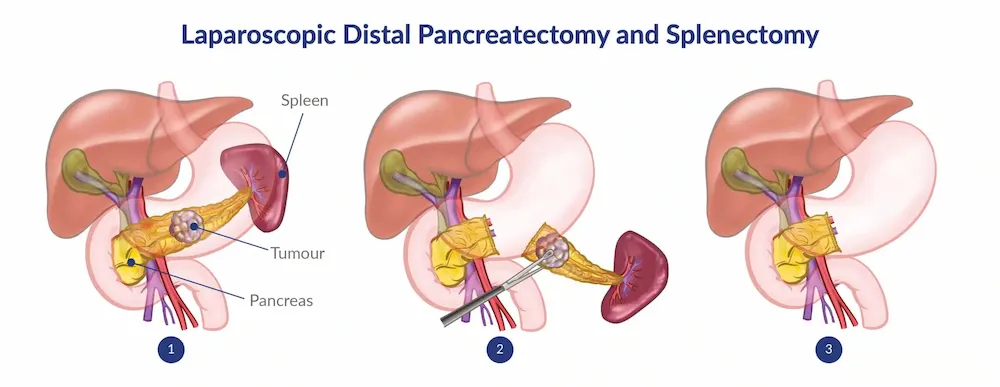
This is one of the most common questions patients ask, and understandably so. The spleen is not diseased, so why remove it?
The answer lies in anatomy. The main blood vessels supplying the spleen, the splenic artery and splenic vein, run directly along the body and tail of the pancreas. When a tumour is close to these vessels, or when the surgical approach requires dividing them to safely remove the pancreatic tail, the spleen can lose its blood supply and needs to be removed with it.
In some cases, particularly for benign disease, a spleen-preserving distal pancreatectomy is possible. The surgeon carefully separates the pancreas from the splenic vessels rather than dividing them, allowing the spleen to remain in place.
This isn’t always technically possible or oncologically appropriate, especially if the tumour is malignant and close to the vessels, but it is discussed with every patient where it may be an option.
Losing the spleen is manageable. Most adults live full, active lives without one, with some precautions around infection prevention, which we cover further down this page.
How Is a Pancreatectomy Performed?
Both partial and total pancreatectomy can be performed via open surgery or minimally invasive techniques (laparoscopic or robot-assisted), depending on the size, location and nature of the disease, as well as the patient’s overall fitness.
For a distal pancreatectomy, the surgeon accesses the pancreas through the abdomen, carefully separates the body and tail from surrounding structures, and removes the affected section along with the spleen if required. The remaining pancreas is closed securely to reduce the risk of leakage.
For a total pancreatectomy, the entire gland is removed along with the spleen and, depending on the extent of disease, portions of the stomach, bile duct or small intestine. The remaining digestive tract is then reconnected to preserve normal function as far as possible.
Minimally invasive approaches typically involve smaller incisions, less blood loss and a faster return to daily activity, though not every case is suitable for this approach. Your surgeon will recommend the safest method based on your specific scans and health profile.
How a Pancreatectomy Differs From a Whipple Procedure
The Whipple procedure removes the head of the pancreas along with the duodenum, gallbladder and part of the bile duct. It is the standard operation for tumours in the head of the pancreas.
A partial (distal) pancreatectomy instead addresses the body and tail, and does not usually involve the duodenum, stomach or bile duct. A total pancreatectomy is the most extensive option, removing the entire gland regardless of where the disease originally started, and is typically considered when disease is too widespread for a partial resection to be curative.
Who May Require a Pancreatectomy?
Partial or total pancreatectomy may be recommended for:
- Tumours or cysts located in the body or tail of the pancreas
- Pancreatic cancer confined to the body or tail with no spread beyond the pancreas
- Chronic pancreatitis causing persistent pain or complications
- Pancreatic neuroendocrine tumours
- Widespread disease affecting the entire gland, in the case of total pancreatectomy
As with any major surgery, this approach may not be suitable if the cancer has spread beyond the pancreas, if other serious medical conditions significantly increase surgical risk, or if overall health makes recovery from major surgery unlikely.
A full assessment, including imaging and a review of your medical history, is needed before a recommendation is made.
Risks and Recovery
Like all major abdominal surgery, partial and total pancreatectomy carry real risks, which your surgeon will discuss in detail before proceeding. These can include:

- Pancreatic fistula (leakage of digestive fluid from the remaining pancreas)

- Delayed gastric emptying, causing temporary nausea or difficulty eating

- Bleeding or infection at the surgical site

- New or worsened diabetes, particularly after total pancreatectomy

- Increased infection risk if the spleen has been removed
Most patients spend their first days after surgery focusing on pain control, gentle movement and a gradual return to eating. Hospital stay and recovery time vary by procedure, as outlined in the comparison table above.
Nutrition support, including small frequent meals and enzyme supplements if needed, plays a meaningful role in a smoother recovery.
Life After Pancreatectomy
Life after surgery depends heavily on how much of the pancreas remains. Patients who retain a working portion of the pancreas may have normal or near-normal digestion and blood sugar control.
Patients who undergo a total pancreatectomy will require regular insulin to manage blood sugar and enzyme replacement to support digestion, since neither function can be performed without the gland.
If the spleen has been removed, your care team will usually recommend vaccination against certain bacterial infections (such as pneumococcus, meningococcus and Haemophilus influenzae), ideally before surgery where possible, in line with CDC guidance for patients without a functioning spleen.
This is a standard, well-established precaution, and most patients who have had a splenectomy go on to live full, active lives with no unusual restrictions.
Final Thoughts
If you are weighing up a diagnosis or a surgical recommendation, a personalised discussion with a specialist remains the most reliable way to understand your specific situation.

The specialist leading your care
Dr Thng Yongxian
Medical Director, Senior Consultant Pancreas & Hepatobiliary Surgeon
20+ Years of Experience
MBBS (SG) • MMed (Surg) • MRCS (Ire) • FRCSEd (Gen) • FAMS (Surg)
Dr Thng Yongxian is a fellowship-trained HPB and general surgeon with specialised training in minimally invasive and complex abdominal surgery.
He previously served as Clinical Lead for his institution’s Hepatopancreatobiliary (HPB) Surgery Department and has extensive experience managing conditions of the liver, gallbladder, pancreas and bile ducts, including pancreatic cancer surgery such as the Whipple procedure (pancreaticoduodenectomy) and pancreatectomy.
In addition to pancreatic cancer surgery, Dr Thng performs advanced laparoscopic procedures and has contributed to national initiatives, including serving on the Ministry of Health Laparoscopic Cholecystectomy Clinician Workgroup for value-driven care.
His surgical work has been presented at international conferences, reflecting ongoing engagement in clinical practice and surgical education.
Patients under his care receive careful evaluation and individualised treatment planning based on their clinical condition and overall health.
Keyhole Surgery Expertise
Focused on Patient Safety
Timely Access to Care
Support with Insurance Pre-Authorisations
Frequently Asked Questions
What is the difference between a partial and a total pancreatectomy?
A partial pancreatectomy removes only the diseased section of the pancreas, most commonly the body and tail. A total pancreatectomy removes the entire gland and is reserved for more extensive disease.
Why does the spleen sometimes need to be removed with the pancreas?
The spleen shares its blood supply with the body and tail of the pancreas. When these vessels must be divided to safely remove the pancreas, the spleen is removed at the same time.
Is spleen preservation always possible?
Not always. It depends on the location and nature of the disease. Your surgeon will assess whether a spleen-preserving approach is appropriate and safe for your specific case.
Can you live a normal life without a pancreas?
Yes, with adjustments. Patients who have had a total pancreatectomy require lifelong insulin and enzyme supplements, but can otherwise lead active, normal lives with proper medical management.
Can you live without a spleen?
Yes. The spleen supports immune function, but most adults adapt well after splenectomy, particularly with recommended vaccinations and, in some cases, longer-term antibiotic precautions.
How long is recovery after a distal or total pancreatectomy?
Distal pancreatectomy recovery typically takes four to eight weeks. Total pancreatectomy recovery is longer, generally eight to sixteen weeks, given the more extensive nature of the surgery.
Will I need insulin or enzyme supplements for life?
This depends on how much functioning pancreas remains. Total pancreatectomy patients will need both. Partial pancreatectomy patients may need one, both, or neither, depending on individual recovery.
Pancreatectomy vs Whipple procedure
The Whipple procedure addresses tumours in the head of the pancreas and involves the duodenum, gallbladder and bile duct. Partial and total pancreatectomy address the body, tail, or entire gland, without necessarily involving those structures. Read our Whipple procedure guide for a full comparison.
Corporate & Personal Insurance Plans
Our Clinic Location
@ Gleneagles Hospital Annexe Block
Precision Surgical Centre @ Gleneagles Hospital Annexe Block
- 6A Napier Road, #03-32 Gleneagles Annexe Block Singapore 258500
- (65) 9838 5827
- (65) 9838 5827
- gleneagles@precisionsurgicalcentre.com
-
Mondays to Fridays: 9.00am - 5.00pm
(Lunch: 1:00pm - 2:00pm)
Saturdays: 9.00am - 1.00pm
Sundays & PH: Closed
Need help navigating your health?
If you’re experiencing symptoms or want to understand your treatment options, contact us today.