
家 » Whipple Procedure Explained
Understanding the Whipple Procedure (Pancreaticoduodenectomy): A Vital Surgery for Pancreatic Conditions

童永贤博士
Medical Director & Senior Consultant Hepatopancreatobiliary Surgeon
Specialist in Pancreatic, Liver, Gallbladder & Bile Duct Conditions
内外全科医学士 (MBBS) • 医学硕士 (MMed) • 爱尔兰皇家外科医师学会会员 (MRCS (IRE)) • 爱丁堡皇家外科医师学会会员 (FRCSED) • 印度医学科学院院士 (FAMS)
Table of Contents
- What is the Whipple Procedure?
- What Does the Whipple Procedure Aim to Resolve?
- How Is Whipple Surgery Different from Other Pancreatic Surgeries?
- Who Is the Whipple Procedure Recommended For?
- Weighing Risk and Benefit in Pancreatic Cancer Surgery
- Life After Whipple Surgery
- Frequently Asked Questions (FAQ)
Surgery for pancreatic or bile duct cancer is never a simple decision. Among the options available, the Whipple procedure – also known as pancreaticoduodenectomy – remains the standard of care for certain tumours in the pancreas, bile duct, and small intestine. In this page, we explain what the procedure involves, who may need it, how to prepare and what to expect during recovery.
What is the Whipple Procedure?
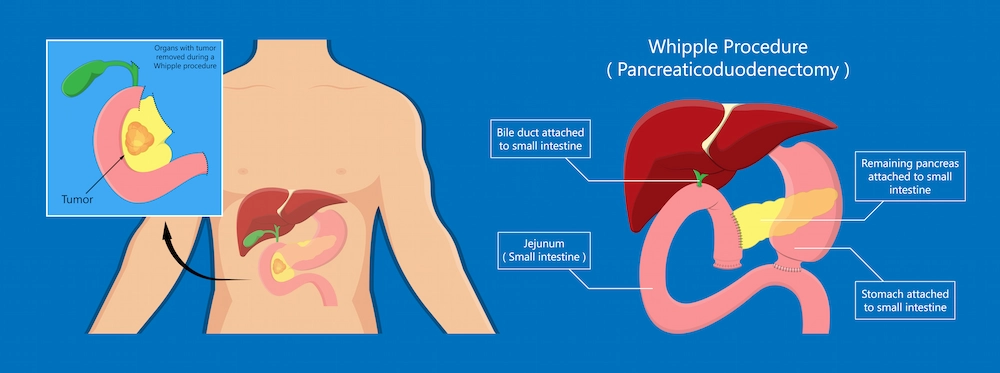
The Whipple procedure is a major surgery designed to treat pancreatic cancer, tumours, or other conditions in the head of the pancreas, where many of these issues tend to arise.
The surgery involves removing the head of the pancreas, parts of the small intestine (the duodenum), the gallbladder, and sometimes portions of the bile duct and stomach. They are then carefully reconnected to allow for normal digestion and bile flow.
A modified version of the surgery, known as the pylorus preserving Whipple, keeps the stomach and its lower valve intact rather than removing part of the stomach. Where the tumour allows for it, surgeons will often favour this approach, as it can help preserve more normal digestive function afterwards.
Though the Whipple procedure is challenging and carries risks, it is often the best option for patients with early pancreatic cancer stages, where the disease remains localised to the pancreas.
The aim of the surgery is not only to remove the tumour but also to give patients a better chance of survival and quality of life moving forward.
For individuals diagnosed with pancreatic cancer, determining whether the tumour is suitable for surgical removal requires careful staging and multidisciplinary discussion. An assessment by a pancreatic cancer surgeon can help clarify treatment options and guide the next steps in management.
What Does the Whipple Procedure Aim to Resolve?
Whipple surgery primarily aims to address diseases affecting the pancreas, such as:
For patients with localised pancreatic cancer, undergoing pancreaticoduodenectomy offers a chance at curative treatment, giving them the possibility of longer life and relief from the pain and complications associated with untreated pancreatic conditions.
- 胰腺癌: The most common reason for this surgery, when the tumour is confined to the head of the pancreas and has not spread to other organs.
- Chronic 胰腺炎: Severe, long-term inflammation of the pancreas that leads to irreversible damage and complications.
- 胰腺囊肿 or Tumours: Benign tumours or cysts that block the bile duct or cause digestive issues.
- Pancreatic Neuroendocrine Tumours (PNETs): Tumours arising from the hormone-producing cells of the pancreas, which may require a Whipple procedure when located in the head of the gland.
- Bile Duct Obstruction: When the bile duct becomes blocked, either by a tumour or other causes, the Whipple procedure can help restore normal bile flow.
How is the Whipple Procedure Carried Out?
The Whipple procedure or Pancreaticoduodenectomy is a delicate, multistep process that requires careful planning and skill:
To explain it simply, the surgery involves making a large incision in the abdomen and removing the head of the pancreas, duodenum, gallbladder, and sometimes part of the bile duct, stomach, or nearby lymph nodes, depending on the extent of the disease.
After the affected organs are removed, the remaining portions of the pancreas, bile duct, and stomach or small intestine are reconnected to allow digestion to continue as normally as possible.
Because of the number of organs involved and the complexity of reconstruction, the procedure typically takes 6 to 8 hours to complete. It can be carried out either via open surgery or laparoscopically (keyhole surgery).
While the Whipple operation is traditionally carried out via open surgery, with an experienced surgeon, both laparoscopic surgery and open surgery yield similar outcomes.
How Is Whipple Surgery Different from Other Pancreatic Surgeries?
While other surgeries, like the distal pancreatectomy, remove only parts of the pancreas, the Whipple procedure involves the removal of the head of the pancreas along with nearby structures.
This makes it more comprehensive, especially in the treatment of pancreatic cancer or conditions that affect the head of the pancreas.
A total pancreatectomy, on the other hand, involves removing the entire pancreas – this is carried out often in cases of advanced disease.
| Whipple Procedure | Distal Pancreatectomy | Total Pancreatectomy | |
|---|---|---|---|
| What is removed | Head of the pancreas, duodenum, gallbladder, part of the bile duct | Body and/or tail of the pancreas, often with the spleen | Entire pancreas and spleen, sometimes parts of the stomach or bile duct |
| Typical use | Tumours in the head of the pancreas | Tumours or cysts in the body or tail | Disease spread throughout the gland |
| Duration | 6 to 8 hours | 2 to 5 hours | 5 to 9 hours |
| Hospital stay | 6 to 12 days | 5 to 10 days | 10 to 21 days |
Who Is the Whipple Procedure Recommended For?
Whipple surgery may be appropriate for patients diagnosed with localised pancreatic cancer or other conditions affecting the head of the pancreas.
It is typically recommended for individuals who are medically fit for major surgery and have no evidence of cancer spread beyond the pancreas.
Not every patient diagnosed with pancreatic cancer will be eligible. Only around a fifth of patients are typically found suitable for surgery at diagnosis, and further imaging or a staging procedure can sometimes rule out surgery even in patients initially thought to be candidates. This is why a thorough assessment matters before any surgical plan is confirmed.
However, this approach may not be recommended if:
- The cancer has spread to other organs.
- You have other serious medical conditions that increase the risks of surgery.
- Your overall health is poor, and recovery would be unlikely.
If you’re unsure whether you’re a suitable candidate, speak with your surgeon to explore your options.
Preparing for Whipple Surgery
Preparation plays a key role in improving outcomes after Whipple surgery. A full medical review helps determine whether the procedure is suitable and safe. Lifestyle changes and optimising your nutritional status can also support a smoother recovery.
Key steps to take before surgery include:
- Medical assessment: Ensure you are fit for major surgery and that the cancer has not spread.
- Stop smoking and limit alcohol: Both can increase the risk of complications.
- Review medications: Inform your doctor if you're on blood thinners or other longterm medications.
- Improve nutrition: Aim to maintain a healthy weight and muscle mass. If appetite is poor, consider small, frequent meals or supplements.
Weighing Risk and Benefit in Pancreatic Cancer Surgery
Like every surgery, the Whipple procedure comes with its own set of risks. These risks include:

- Delayed gastric emptying, which can cause temporary nausea and vomiting

- A pancreatic fistula due to digestive enzymes leaking into the abdomen

- Difficulty digesting certain foods as parts of the digestive tract are removed or rerouted

- Diabetes

- Bile duct leakage
Despite these risks, the Whipple procedure remains one of the most effective – and at times the only – potentially curative treatments for cancers of the pancreas, bile duct, and duodenum.
With experienced surgical teams and improved post-op care, outcomes have steadily improved. In many cases, the potential benefits far outweigh the risks, especially when surgery is performed by an experienced surgeon.
Concerned about a diagnosis?
Consult our specialist for treatment guidance or a second opinion.
Life After Whipple Surgery
Recovery continues well after discharge, with most patients returning to normal daily activity within six to eight weeks and the digestive system settling gradually over the months that follow.
For many, this period brings a few lasting changes worth understanding, alongside a schedule of monitoring to keep track of recovery and recurrence risk.
Digestive Changes
The digestive system often needs time to adjust after surgery, and for some patients certain changes persist over the long term. These can include:
- Trouble absorbing nutrients from food
- Unintended weight loss
- Looser or more frequent bowel movements
- Ongoing need for pancreatic enzyme replacement therapy (PERT)
A dietitian can be a valuable part of the care team here, helping fine-tune meals and enzyme dosing so patients get enough nutrition without triggering discomfort.
Diabetes Risk
Because part of the pancreas is removed, its ability to produce insulin can be reduced. This does not mean every patient will develop diabetes, but blood sugar should be monitored, and some patients go on to need medication or insulin to keep it well controlled.
Ongoing Monitoring
Surgery is rarely the final step. Patients are typically followed up over the months and years afterward, which may involve:
- Periodic scans, such as CT imaging
- Blood tests, including tumour markers like CA 19-9
- Clinical check-ins to watch for any signs of recurrence
Many patients also go on to receive chemotherapy or radiation after surgery, aimed at lowering the chance of the cancer returning.
Final Thoughts
The Whipple procedure is a complex operation, but for many patients, it represents the best chance of long-term remission, improved quality of life, or even cure.
If you’re considering this procedure, it’s important to have open discussions with your healthcare team to fully understand the risks, benefits, and whether it’s appropriate for your condition.
If you have any questions, feel free to get in touch. This article is part of Dr Thng’s ongoing effort to make educational content on hepatopancreatobiliary health accessible to all.

The specialist leading your care
童永贤博士
Medical Director, Senior Consultant Pancreas & Hepatobiliary Surgeon
MBBS(新加坡)• MMed(外科)• MRCS(爱尔兰)• FRCSEd(普通)• FAMS(外科)
唐永贤博士是一位 fellowship-trained HPB and general surgeon with specialised training in minimally invasive and complex abdominal surgery.
He previously served as Clinical Lead for his institution’s Hepatopancreatobiliary (HPB) Surgery Department and has extensive experience managing conditions of the liver, gallbladder, pancreas and bile ducts, including pancreatic cancer surgery such as the Whipple procedure (pancreaticoduodenectomy) and pancreatectomy.
In addition to pancreatic cancer surgery, Dr Thng performs advanced laparoscopic procedures and has contributed to national initiatives, including serving on the Ministry of Health Laparoscopic Cholecystectomy Clinician Workgroup for value-driven care.
His surgical work has been presented at international conferences, reflecting ongoing engagement in clinical practice and surgical education.
Patients under his care receive careful evaluation and individualised treatment planning based on their clinical condition and overall health.
微创手术技术
Focused on Patient Safety
Timely Access to Care
Support with Insurance Pre-Authorisations
Frequently Asked Questions
Is the Whipple procedure the same as a pancreaticoduodenectomy?
Yes. Pancreaticoduodenectomy is simply the medical term for the Whipple procedure.
What are the survival rates and prognosis after the Whipple procedure?
The five-year survival rate after a Whipple procedure for pancreatic cancer is generally around 20 to 25 percent, higher than the roughly 10 percent seen across all stages combined. Outcomes depend on factors like tumour size and how early the cancer was caught.
What happens if the cancer turns out to be inoperable once surgery has started?
Surgeons confirm a tumour can be safely removed before committing to the full procedure. If it turns out to be more advanced than expected, the team may stop short of full resection and discuss other treatment options with you afterwards.
What can I expect immediately after surgery, before going home?
You’ll be closely monitored on the ward, with drains in place while the reconnected organs heal. Diet is reintroduced gradually, and you’ll be encouraged to move around early to help lower the risk of complications.
Can pancreatic cancer return after a Whipple procedure?
Recurrence is possible, which is why follow-up scans and blood tests continue well after surgery. Many patients also receive chemotherapy or radiation to help lower this risk.
How much does the Whipple procedure cost in Singapore?
Cost depends on factors such as hospital choice, ward class and case complexity. See our guide to pancreatic cancer surgery costs for a detailed breakdown.
How long does recovery take after Whipple surgery?
Most patients stay in hospital for six to twelve days and return to normal daily activity within six to eight weeks, though full digestive recovery can take several months.
Is the Whipple procedure insurance claimable?
Often, yes, though this depends on your specific policy and panel status. Check with your insurer and the hospital’s admissions team beforehand to confirm coverage.
Can I seek a second opinion?
Yes, and it’s a reasonable step before major surgery. Most surgeons are used to patients seeking one.
Corporate & Personal Insurance Plans
诊所地址
@ 鹰阁医院附属楼
精准外科中心 @ 鹰阁医院附属楼
- 新加坡纳皮尔路6A号,鹰阁附属楼#03-32室,邮编258500
- (65) 9838 5827
- (65) 9838 5827
- gleneagles@precisionsurgicalcentre.com
-
周一至周五: 上午9点至下午5点
(午餐时间:下午1:00-2:00)
星期六: 上午9点至下午1点
周日及公共假期: 关闭
Need help navigating your health?
如果您出现相关症状或想了解您的治疗方案,请立即联系我们。.
References:
- Traverso LW, Kozarek RA. The Whipple Procedure for Severe Complications of Chronic Pancreatitis. Arch Surg. 1993;128(9):1047–1053. doi:10.1001/archsurg. 1993.01420210111015
- City of Hope. Whipple Procedure (Pancreaticoduodenectomy). https://www.cityofhope.org/clinical-program/pancreatic-cancer/treatments-survival/whipple-procedure
- Pancreatic Cancer Action Network. Whipple Procedure (Pancreaticoduodenectomy). https://pancan.org/facing-pancreatic-cancer/treatment/treatment-types/surgery/whipple-procedure-pancreaticoduodenectomy/
- UChicago Medicine. Whipple Procedure: Frequently Asked Questions. https://www.uchicagomedicine.org/cancer/types-treatments/pancreatic-cancer/treatmentservices/whipple-procedure
- UPMC Hillman Cancer Center. Whipple Surgery for Pancreatic Cancer. https://hillman.upmc.com/cancer-care/pancreatic/treatment/surgery/whipple